Person Record
Metadata
Name |
Cadigan, George Leslie (Bishop) (1910-2005) |
Born |
1910 |
Birthplace |
Mt Vernon, NY |
Places of Residence |
Lovell, ME summer resident |
Education |
Amherst College, Episcopal Theological Seminary - Cambridge, MA, Cambridge University - England |
Notes |
(2) Married Aug 12, 1944 Buried in Cemetery No. 4. Taken from the Summer 2015 Newsletter, written by Rufus Cadigan: "As a family of six we spent the months of July and August at our home by Lake Kezar beginning in the 1950s. It was here in Lovell that I best got to know Dad. It was here that he showed me how to be an outdoorsman. In Kezar we swam, fished together, and paddled our Old Town canoe; we camped out and told stories together on the Saco. My Mom and Dad, Jane and George Cadigan, first came to Lovell in the summer of 1946 after their friends in Massachusetts suggested that they would enjoy Conifer. Dad was a minister at Grace Episcopal Church in Salem, Massachusetts. Mom was the caretaker first of my brothers Peter and David and then later of myself and Christine. front property which was a cutover area that had blackberries on it, hence the name of our place Blackberry Hill. Dad hired Frank Lopez, the editor of Architectural Record and a former cabin boy at Conifer, to be the architect for our new house. It was Lopez’s first house to design. One of the carpenters Dad hired was Jack Muench, a well-known artist, because he could read Lopez’s blueprints. He earned the biggest salary of the carpenters at $1.25 an hour. The second carpenter was Lawrence "Stoney" Stone who happened to be the strongest man in Lovell and got $1.00 an hour. The third was Steve Hinrichs, a teacher at Exeter, who earned $.75 an hour. Dad worked with these three and both my brothers Peter and David helped too. The house was finished and ready for us in the summer of 1953. Dad and Mom had to borrow to pay for the property, the house and the furnishings. They were astounded at the enormous expense of $10,000 for a waterfront home at Kezar. Both my parents talked of Blackberry Hill as their spiritual home. Dad described how the six of us would ride in our Old Town canoe from our landing to the sandy beach at Conifer for our twice-daily swims. That same craft would take us down the outlet to Charles Pond, or two-day trips down the Saco. We paddled Sucker Brook and studied great blue heron, loons, Canadian geese and wood ducks. We took it as far as a beaver dam, and in season found the cardinal flowers (red lobelia) and the snake mouth orchids. Sometimes we saw eagles, osprey, hawks and least bittern. There were always huge turtles and the occasional otter. What a beautiful wild area…. Dad would teach my brothers and me to play King of the Raft. He got on one side, I on the other. Each of us would try to throw the other one off the raft into the lake. Dad wrote, 'I don’t recall how old I was or how old you were when you dethroned me. Remember how you had to swim almost a mile from the Narrows Bridge to the Conifer Beach before you were allowed to take the canoe alone? You did it when you were eight or nine years old.' One summer when I was about eight, Dad and George Chapman took his son Beau and me for a camping trip on Wild River near Lovell. This time Dad taught me how to plan a menu, pack gear, set up a fire, cook a meal and assemble the pup tent. After supper around the fire, Beau’s dad entertained us with stories of his work as a lawyer 'catching bad guys' for the F.B.I. That night the temperature fell to 30 degrees. I got so cold I couldn’t sleep even when I had thrown all my clothes over me in my sleeping bag. I was coughing the whole night. At about 3 am Dad got worried about me and said, 'Rufus, are you all right?' I said, 'Daddy, this is the most wonderful day of my life.' Another summer a terrible thunder storm knocked out our electricity for at least a week. Dad and Mom were good game-masters, keeping the children entertained when darkness fell. During this black-out they organized a hide-and-seek game called 'Sardines'. It was always hard for me to find the person who was selected to hide somewhere crammed into a corner of the house in complete darkness. To play this with my parents is a treasured memory. When in Lovell Dad found himself most at peace. This was where he could step into his wild side. He loved to clown around with those who were merry makers too. One of them was Julia Carnegie who had ruled the Conifer kitchen for decades. One evening after dinner at Conifer in the 1950s, George stepped into Julia’s kitchen to tell her how much he admired her chef’s hat and wanted it for himself. Without a pause, he flipped the chef’s hat off her head, stuffed it on his own and danced around the kitchen with it. Julia picked up a huge carving knife and chased him. The kitchen staff and I watched bug-eyed. Eventually Julia and Dad collapsed into laughter. George’s other jokester friend was Fred Semple. In the 50s and 60s, Dad and Fred played as duo-entertainers for our two families. Every summer we all had a ride on Fred’s steamboat and then a picnic at Del Cram’s beach on the lower lake near Miss Hobbs’ house. Later in the evening the show happened at Fred’s large steam engine workshop at Fred and Princie’s first Lovell home where the Marina is now. Fred opened the act. He would turn his back to us and prepare his magic secretly. Then suddenly he turned around while blowing out a huge dragon breath of fire. I remember seeing at least two feet of fiery flames from his mouth. We kids yelled happily at his home circus spectacle. Dad would have the closing act. Under the spotlight he carefully selected one of Fred’s nails from his nail box and hammered it into one of his thighs without ever hurting himself. Princie and my Mom would scream out pretending to be frightened. Dad would swiftly pull the nail out of his leg without an ounce of blood. He was the Houdini of Lovell. When I was about twelve I urged Dad to show me how he did his trick. He explained a little bit of it but not enough for me to figure out how to do it on my own. A good father knows where the boundaries are. Dad would talk about how he felt closer to God when he was in Lovell. Looking up at the White Mountains from our Blackberry Hill House in the mornings, he would sometimes show me where he saw the sign of the Cross on the side of Baldface. I couldn’t see it but I know he did. Some people would say to him, 'Oh, yes, George, I see it now that you’ve pointed it out'. I’m looking at Baldface right now as I’m typing up this story about Dad on our deck and it still ain’t there for me! In the 50s and 60s Dad had 'chapel' every morning on the deck as the family faced Kezar and the mountains. Each of us was given a hymnal book to sing from daily. Dad would read aloud a little bit of the Bible. I usually enjoyed this family 'chapel' service but got a little embarrassed when my friend Tony Muench was around the house and would be asked to join us for family chapel time. I didn’t think Tony’s family ever did chapel services together. Tony confirmed this when I saw him at the Davey house after Sally Davey’s funeral last August. But there was no need to worry; Tony went along easily with our family service as a good member of the congregation. Unlike many of us, Dad wasn’t embarrassed to talk about his religious beliefs. He knew how to talk in such a natural way that one didn’t feel pressured or overwhelmed. On Sunday mornings we always went to the Congregational Brick Church. Dad preached there and at the Center Lovell Church on several Sundays every summer. He often talked about nature when he preached to the Lovell congregations. People still talk to me in Lovell about how much Dad’s sermons meant to them such as the one on dry flies and fishing. Before church on Sundays Dad first drove us to the Kimball & Walker General Store just across the road. Mom gave either Fred or Barney a list of shopping items and then we walked over to the church. After the service we walked back to the store to pick up the food from Mom’s list, packed and ready for us in boxes. Dad spoke about Kimball & Walker General Store as "that special place where you could purchase anything you needed. In the early 50s, our monthly grocery bill for the six of us was just about $100. Remember how those unusual men, Fred and Barney Walker, gave credit all winter long to the needy?" One time when Dad was at the store he saw a fishing rod with a sign which read 'Purchase a raffle ticket for only fifty cents and you might win this rod'. Dad thought that this might be a benefit for the Volunteer Fire Department. He asked Fred, 'For what benefit is this rod being sold?' Fred said, 'Benefit of Kimball & Walker!' Kimball & Walker served your needs for any occasion. Dad remembered that the store had no license to sell liquor, but that didn’t stop Dad’s friend Charlie Feld (Andy’s father) showing up at the store one Sunday and asking how he could find a bottle of gin he needed: 'Barney disappeared into his home across the street and returned with a shoe box, all neatly wrapped. ‘Charles,’ he said, ‘these shoes will cost you $5.00’. Dad enjoyed telling a good story. One summer he took us along with some girls who worked at Conifer for a climb up Speckled Mountain. Here’s his recollection: It is a three hour climb but the ascent is not difficult. We were less than an hour on the trail when it began to rain and heavy fog enveloped us. Nevertheless we pushed on to the summit. There we sat on the rocks and had our picnic lunch. By this time the mist was even thicker and the visibility was less than ten yards. Suddenly out of the swirling clouds walked a man absolutely nude and all red from his exertion. Each of the children and myself gaped at him. He did wear one thing, a wrist watch. He glanced at this and said, ‘Two hours from Wild River, not bad, hey!" Then he moved apart from us and lay down on the rocks. Very quietly Rufus spoke to me, "Daddy is he an Indian"? We finished our lunch almost in silence and then our clothesless climber said goodbye and disappeared into the fog. When we descended to the A.M.C. hut at the foot of the trail we told the hut boy about this nude man. "Oh," he said, "that’s Nature Boy." My own memory of this story is slightly different. Nature boy was wearing a blue loin cloth held together by a silver chain around his waist. Now many decades later who knows what Nature Boy was wearing or not. I should add that my father would tell me that a good story always needs to be embellished. Indeed he was a superb storyteller…and card player. Bishop Cadigan was a card shark in Lovell where he taught us kids how to gamble with "21". He began the game by passing each of us a pile of wooden match sticks. After playing just a few hands, he always won and took away most of my stash of match sticks. Dad was never the father who purposely lost so that his child could win. We kids tried wholeheartedly to beat the man but the gambling Bishop easily trumped us. He was of course a gentle kindly religious man. Nevertheless he was also the tough casino guy in Lovell-Las Vegas. However, Dad could not master any single skill in the kitchen. He was a typical 50s husband and father, hopeless beyond pouring milk into the cereal bowl. Cleverly, Dad married Jane who was a superb cook. With all six of us living at Blackberry Hill, Mom alone prepared all 21 meals a week. Mom was also a wonderful artist who worked both with watercolor and wood prints. Her art work can be seen in Lovell homes today. She created much of her art from views of the woodlands of Lovell and Kezar Lake. Her artistic gift and Dad’s public speaking abilities must have been what gave me such a love for art and the theater. As the Bishop of the Episcopal Diocese of Missouri (1959-75), Dad worked to bring people together. Cardinal Ritter Archbishop of St. Louis and Dad endorsed one of the first ecumenical weddings; it was celebrated by the Catholic and Episcopal Church. Dad was the first non-Roman Catholic ever to preach in a Catholic Church. He met with Martin Luther King, Jr. in St. Louis to stand for racial equality, fair housing and employment. But it was in Lovell that I knew him best. As a great outdoorsman, he loved fly-fishing, canoeing, hiking, tennis and golf. He loved the nature of Lovell and was one of the founders of the Greater Lovell Land Trust and Director Emeritus. Of his life here Dad said, 'I rejoice that I raised the money to preserve land as a wilderness forever.' His gifts of richness have never stopped giving. One of these gifts is a letter he wrote: 'Here is a mystery in sun and stars, in night and day, in snow and rain. May you ever be sensitive to these things of creation. May you grow up with them on skates and skis, on mountain trails and down the rivers. Then when you move with men and make decisions you may know over and above the market price that lumber comes from trees, that mutton comes from the sheep, that power comes from water, and that bread comes from fields of waving wheat.' Written in June 1946, this was a letter to me when I was a few weeks old. A few weeks after that he and Mom carried me in their hands to Conifer, Lovell." |
Occupation |
Episcopal Priest, seventh Bishop of the Episcopal Diocese of Missouri. Trustee of Amherst College and Hobart College and Sewanee University. |
Spouse |
(1) Charlotte Cadigan (Young), (Died 1943), (2) Jane J. Cadigan (Jones), (Died 1 |
Children |
Peter Young Cadigan David Quincy Cadigan Rufus Jones Cadigan Christine (Cadigan) Jones |
Deceased |
Dec 14, 2005 |
Deceased Where |
Topsham, ME |
Titles & honors |
Amherst College dedicated its Center for Religious life in his name. Honerary doctorates from Hobart College and Sewanee University |
Related Records
-
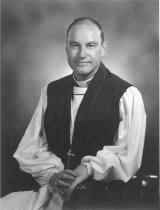
Bishop George Cadigan - 2007.37.0003
Portrait of Bishop George Cadigan. Taken from Photo CD #2.
Record Type: Photo
-
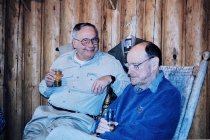
Bob Patterson & George Cadigan - 2024.02.0004
Bob Patterson sitting on a porch at Kezar Lake with George Cadigan. Taken from Photo CD #19.
Record Type: Photo
-
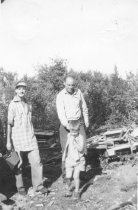
Building the Cadigan Camp - 2014.42.0003
Building the Cadigan's camp in the 1950s. In the picture is Lawrence Stone, George Cadigan, and his son Rufus. Taken from Photo CD #10.
Record Type: Photo
-
Cadigan, Bishop George - 1974.02.1002
Information on Bishop George Cadigan. Located in the file category "People".
Record Type: Archive

-
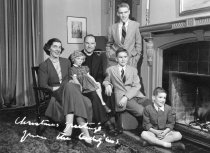
Cadigan Family - 2018.10.0217
Christmas card photo of the Cadigan family. The year is not identified.
Record Type: Photo
-
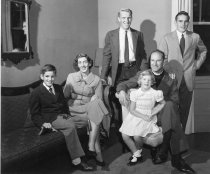
Cadigan Family - 2018.10.0218
Christmas card photo of the Cadigan family. The year is not identified.
Record Type: Photo
-
-
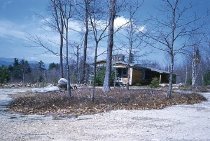
Cadigans Camp, 1961 - 2001.12.0027
Three photographs of the Cadigan's camp in 1961. The house was built by Lawrence Stone. Taken from Photo CD #2. CD0216 was used in the Summer 2015 Newsletter.
Record Type: Photo
-
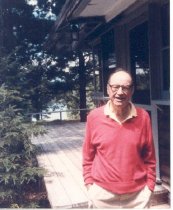
George Cadigan at his Summer Home - 2007.37.0005
George Cadigan standing on the deck of his home on Kezar Lake.
Record Type: Photo
-
George Cadigan Family - 2014.42.0004
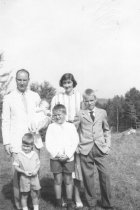
The George Cadigan family standing near their camp at Conifer in the 1950s. Back row, left to right: George, baby Christine, Jane. Front row, left to right: Rufus, David, Peter. Taken from Photo CD #10.
Record Type: Photo
-
George Cadigan, Fish, and Friends - 2007.37.0004
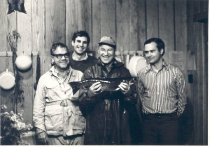
George Cadigan holding a fish during a fishing trip with three unidentified men.
Record Type: Photo
-
George Cadigan Fly Fishing - 2014.42.0005
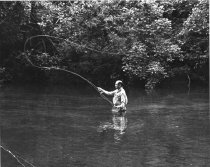
George Cadigan fly fishing. The photo was used in his memorial service brochure. Taken from Photo CD #2. Used in the Summer 2015 Newsletter.
Record Type: Photo
-
George Cadigan Playing Baseball - 2007.37.0001
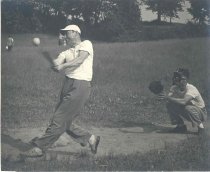
George Cadigan playing baseball. Taken from Photo CD #2.
Record Type: Photo
-
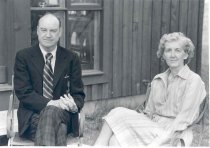
George & Jane Cadigan - 2007.37.0002
George and Jane Cadigan. Taken from Photo CD #2.
Record Type: Photo
-
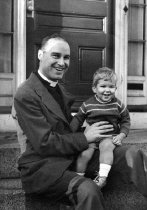
George & Rufus Cadigan, 1948 - 2014.42.0006
George Cadigan with his young son Rufus in 1948, sitting on steps. Taken from Photo CD #2. Used in the Summer 2015 Newsletter.
Record Type: Photo
-
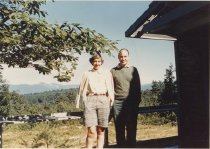
Jane & George Cadigan - 2014.42.0001
Jane and George Cadigan standing outside their camp at Conifer in the 1960s. They named the camp Blackberry Hill. Taken from Photo CD #10.
Record Type: Photo
-
Lovell Cemetery Records, Volume I & II - 2007.31.0001
An update of Lovell's Cemetery Records, originally compiled by Irene St. Germain in 2006 and 2007. A major update was done in 2015, 2019, and 2022. Volume I has an index of names to be found in all Lovell cemeteries and the details on the #4 Cemetery . Volume II has the details on the Center Lovell Cemetery, Fox Cemetery, Lord Cemetery, North Lovell Cemetery, Village, West Lovell Cemeteries, private cemeteries, and an Appendix. The Appendix con...
Record Type: Archive
-
Obituaries - 1974.02.0692
Nine notebooks of obituary newsclippings, all indexed.
Record Type: Archive
-
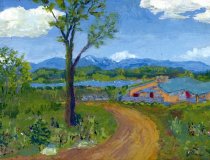
Painting of the Cadigan Camp - 2016.46.0003
Copy of a painting by Ted Davey of Blackberry Hill, the camp of the Cadigans on Kezar Lake. This was presented as a house warming present. Taken from Photo CD #12.
Record Type: Photo
-
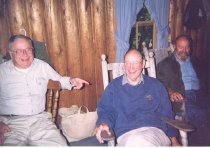
Robert Patterson, George Cadigan & David Cadigan - 2007.37.0006
Robert Patterson, George Cadigan and David Cadigan sitting inside a cabin at Tim Pond, a fishing camp near Eustis..
Record Type: Photo