

Person Record
Metadata
Name |
Stearns, James Cutler Russell (1840-1909) |
Born |
Sep 10, 1840 |
Birthplace |
Lovell, ME |
Places of Residence |
Lovell, ME |
Father |
Stephen Stearns |
Mother |
Mary (Russell) Stearns |
Notes |
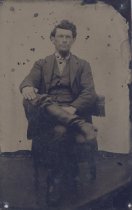
Intentions of Marriage entered Nov 21, 1867 Married Nov 28, 1867 at Lovell by Rev. Joseph Smith Buried at Center Lovell Cemetery Taken from the Spring 2012 Newsletter, written by John & Liz McCann: James C. Stearns was the third of David and Mary Stearns’ eight children. He was born on September 10th, 1840 and died on February 9th, 1909. He lived a typical mid-19th century American life. He was a farmer, logger, meat packer, and day laborer. When he needed work he moved around Maine to find a job. He eventually came back home, married a Lovell girl, and had four children, one of whom died very young. He started life as a farmer’s boy, and ended life as a farmer on the same piece of land where he was born. This is a life story that applies to thousands of Mainers over the generations. He was an ordinary man who personifies all that is right about Maine and the United States. We like our heroes to fit certain molds: fighting against impossible odds; leading a charge against a fortified position; inspiring others to do the impossible. But courage and heroism take many forms. Sometimes it means putting your head down and persevering. Sometimes it means moving forward when so many around you are sick and dying. Sometimes it’s quietly going about your duty without a lot of fuss, whether that duty involves helping save your country, or raising a family, or getting a crop in ahead of bad weather. The origin of the word duty -- that which we owe one another -- seemed to define James Stearns. He fulfilled his duty on many different levels. He was very representative of the Civil War regiment he joined, the 12th Maine Infantry. Always on the edge of what others define as great deeds, somehow never quite grasping the golden ring of fame that came to other Maine regiments in the war, their perseverance was emblematic of the dogged, nay heroic, pursuit of duty. On November 15th, 1861, James Stearns enlisted in Company E of the Twelfth Maine Regiment. The Twelfth was organized to serve for three years. The regiment was part of Gen. Benjamin Butler’s New England division, designed for the capture of New Orleans. On May 4, 1862, the regiment arrived in New Orleans, which had fallen into Union hands the week before. Duty in New Orleans must have both fascinated and bored James Stearns and his fellow soldiers from Maine. A letter from Lt. John W. Dana of the Regiment relayed that they’d spent a safe -- and apparently uneventful – Independence Day in the city. "We enjoyed the dullest Fourth yesterday that I ever knew," he wrote to his father. "Oh! You’ve no idea of it. But I suppose you had great times in the North." While in New Orleans, the regiment performed the duties typical of garrison troops through the ages down to the present day. They guarded various public buildings, including the US Mint. They went on short forays to fight small squads of Confederate soldiers and guerillas, including several trips to the same location, Pass Machac. This was a pass connecting Lake Ponchartrain to the Gulf of Mexico. It seemed the Regiment returned there every few weeks to chase small Confederate forces away. The highlight of these expeditions was the capture of $8,000 in Confederate money. One is left to wonder if they put it in the Mint. While such expeditions were necessary, they never qualified as glorious battles against determined foes. More a break from monotony than anything else. Soldiers know that war is not about glory. Usually war is just dirty, ugly, and sickening. Literally sickening. The Twelfth Maine lost 52 officers and men in battle and 239 died of illness over the course of the war. They died of the things soldiers tended to die of in those days…dysentery, typhoid, pneumonia, measles, tuberculosis, and malaria. The common thread in all these diseases? No one knew how to cure them. While the number of deaths, 239, seems high, in fact it was relatively low when compared to other Civil War regiments, particularly in the Deep South. The 12th had conscientious officers who worked very hard to provide clean and sanitary conditions to the best extent possible. This was a good thing, because getting sick and having to go to the hospital didn’t mean you were going to get better. Civil War hospitals were to be feared. At the outbreak of the war the United States Surgeon General’s office consisted of a total of 115 surgeons; 24 of these resigned to join the Confederate forces. While the numbers on both sides were quickly expanded, it was definitely a "quantity" versus "quality" focus. Nursing services were also quite primitive. The army still relied on male nurses, most of them untrained. Female nurses, when they were used, were likely to be looked down on by the surgeons but were beloved by the wounded for their compassionate care. In March 1863, inspection reports from the Union Army reported a total of 589 hospitals as "good" and 303 as "bad or very bad"…at a time when a good hospital had no antiseptics, doctors who didn’t equate dirt with infection, where anesthesia was a luxury, and drugs were inadequate. The most common non-opium drug was called "blue powder", which was taken orally and consisted of mercury and chalk. While solid numbers are hard to come by, the most reliable statistics for the Union armies give 67,000 killed in action, 43,000 died of wounds, and 224,000 died of disease. A word to the wise: stay out of the hospital. Having apparently kept his health, Stearns, along with the rest of the 12th Maine, was transferred to the Shenandoah Valley of Virginia after serving in Louisiana for over two years. They drew some particular attention as they marched through Washington, DC en route to Winchester, Virginia. According to the Janesville Gazette, August 31, 1864, Union Regiments loved their pets, and the 12th had something special: "The oddest pets we have yet seen were two bears, which the 12th Maine regiment of the 19th Corps, led through the city recently. These bears were brought all the way from Louisiana, and have been in several battles. They have become perfectly tame and tractable, and march along at the head of the band, with an air that indicates they feel themselves veteran soldiers of the bruin order, and that they have a character to sustain." Leave it to Mainers to march with bears! It was in the Shenandoah Valley that the 12th got into their toughest scrape. By the summer of 1864, the Union Army was in seeming control of the Shenandoah Valley. On September 19th, though, that was cast in doubt. According to the Regimental history: "During the evening of the 18th (of September) the Twelfth, with the remainder of the Second division of the 19th Corps was ordered to be in readiness to make a reconnaissance to the front at daylight the next morning. When on the point of moving, the enemy attacked the extreme left of our lines, having taken the 8th Corps by surprise – driving them back thus exposing the flank of the 19th Corps…the Twelfth, being in the front line, occupying rifle pits, remained in its position until many of its number had been struck down by bullets coming from both the flank and rear….The Regiment then received orders to change front, which it did in good order under severe fire from the enemy…(falling) back to a position where the lines of the Corps were rearranged, and there remained until the timely arrival of General (Phillip) Sheridan in person on the battlefield….Reforming his army in one line of battle, it was pushed forward, achieving one of the most complete and decisive victories that had taken place in the Shenandoah." In late November 1864, the Regiment, having completed their 3 years of service, returned to Portland and were officially mustered out. James returned to Lovell and lived with his sister for 3 months, then re-enlisted on March 1, 1865. Having served his full tour of duty, what led this man to decide to go back on active duty? We don’t have his exact reasons, but for many Union soldiers there was a desire to see the thing through to the end. Perhaps the winter in Lovell, after serving nearly 3 years in New Orleans, and fighting with Sheridan in Virginia, seemed pretty dull stuff. In any event, he did re-enlist and was finally discharged on March 13th, 1866. His post-war years are filled with the same sense of duty and commitment to family, friends, and community. He worked a number of jobs from Lovell to Yarmouth, finally returning to Lovell to run the Town Farm for three years. With the money from that job he was able to buy the old family farmstead where he farmed 120 acres, raising crops and running a dairy business. He married Sarah Hatch in 1867 and had four children. He is buried in the Center Lovell Cemetery. An ordinary man in extraordinary times, James Stearns comes across as someone we’d like to know; someone we know we could count on to lend a hand when asked and to do the things that distinguish someone and make them a person of character. What defines greatness in someone? Is it great deeds, or is it a multitude of small deeds done with honor and dignity? The great deeds may be beyond our control. But tackling the small deeds with quiet determination, honor and dignity is well within our ability to control. The best amongst us, men such as James Stearns, show us how to do it. |
Occupation |
Farmer |
Spouse |
Sarah Anne (Hatch) Stearns |
Children |
Mildred D. Stearns 1869 Mabel Estella (Stearns) Jones 1871 Mary R. Stearns 1875 George A. Stearns 1877-1881 |
Deceased |
Feb 8, 1909 |
Deceased Where |
Lovell, ME |
Titles & honors |
Civil War veteran |
Related Records
-
Civil War, File 1 & 2 - 1974.02.0654
Two files of information on Lovell residents serving in the military during the Civil War. Located in the file category "Military".
Record Type: Archive

-
Death Certificates, 1892-1909 - 1974.02.0660
A notebook containing copies of Lovell death certificates from 1892 to 1909. The names are indexed. Information provided on the certificates has been entered into the Past Perfect People Biography. The originals are in an 11x17 archival storgage box labeled "Burial Permits, 1892-1909 and Death Certificates, 1892-1909".
Record Type: Archive
-
Deaths 1892-1939 - 1974.02.1342
Index and photocopy of Lovell's deaths from 1892 through 1939. Located in a notebook titled Births Deaths 1892-1939 Vital Statistics 1910-1945." A photocopy of the book can be found in the archival box "Lovell Vital Records Box 3."
Record Type: Archive
-
Family Records, 1765-1901, Town of Lovell - 1974.02.0689
A transcription of the Lovell Clerk's vital records book titled "Family Records, 1765-1901, Town of Lovell", giving births and deaths. The records were transcribed by Marcia Storkerson and Indexed by Catherine Stone for the Lovell Historical Society November, 2008. Copies can be found at the Historical Society and the Town Office. The transcription can also be viewed on the Lovell Historical Society's website, lovellhistoricalsociety.org, by cl...
Record Type: Archive
-
Family Records, 1784-1837, Town of Lovell - 2009.01.0016
A transcription of the Lovell Clerk's vital records book titled "Family Records, 1784-1837, Town of Lovell", giving births and deaths. The records were transcribed by Marcia Storkerson and indexed by Catherine Stone for the Lovell Historical Society February, 2009. Copies can be found at the Historical Society and the Town Office. The transcription can also be viewed on the Lovell Historical Society's website, lovellhistoricalsociety.org, by cl...
Record Type: Archive
-
James Cutler Stearns - 2011.21.0017
Portrait identified as "My Father" James Cutler Stearns. The photo is taken from an album with the following inscription: "Mrs. Sarah Stearns, Lovell Center, Maine, Dec. 25th, 1886". Taken from Photo CD #7. Original in the Buzzell Family Photo Album archival boxes. Used in the Spring 2012 Newsletter.
Record Type: Photo
-
Lovell Cemetery Records, Volume I & II - 2007.31.0001
An update of Lovell's Cemetery Records, originally compiled by Irene St. Germain in 2006 and 2007. A major update was done in 2015, 2019, and 2022. Volume I has an index of names to be found in all Lovell cemeteries and the details on the #4 Cemetery . Volume II has the details on the Center Lovell Cemetery, Fox Cemetery, Lord Cemetery, North Lovell Cemetery, Village, West Lovell Cemeteries, private cemeteries, and an Appendix. The Appendix con...
Record Type: Archive
-
Marriage Intentions & Certificates - 1974.02.0688
Notebook containing copies of Lovell marriage certificates and intentions primarily from 1833 to 1909. The names are indexed and include maiden names and parents names where available. Information provided on the certificates has been entered into the Past Perfect People Biography. The originals are in an 11x17 archival box labeled "Marriage Intentions and Certificates".
Record Type: Archive
-
Marriage Intentions & Marriages, 1831-1886 - 2022.01.0010
Indexed transcription of the Lovell Clerk's vital records book titled "Marriage Intentions and Marriages, 1831-1886, Town of Lovell." These records were transcribed by Marcia Storkerson and indexed by Connie Miles for the Lovell Historical Society. The transcription and index can be found in an archival notebook labelled "Marriage Intentions & Marriages, Town of Lovell, 1802-1939." A photocopy of the book is located in the archival box "Lovell Vi...
Record Type: Archive
-
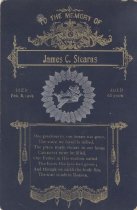
Mourning Card for James C. Stearn - 2011.21.0031
Mourning card for James C. Stearns. Taken from Photo CD #7. Original in the Buzzell Family Photo Album archival boxes. Used in the Spring 2012 Newsletter.
Record Type: Photo
-
Obituaries - 1974.02.0692
Nine notebooks of obituary newsclippings, all indexed.
Record Type: Archive